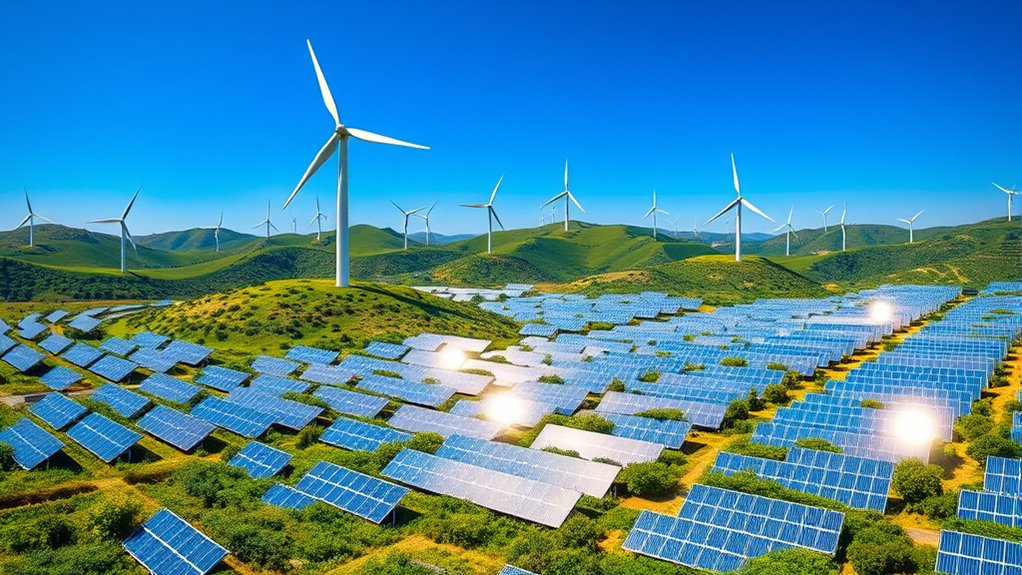

While Bitcoin’s energy consumption often draws criticism, new initiatives are shifting the narrative toward sustainability. Industry trends show over half of the energy used in 2025 could come from renewables like wind, hydro, and nuclear. But can this shift truly make Bitcoin green? As miners increasingly co-locate with renewable projects and support grid stability, the future of eco-friendly mining hangs in the balance—prompting questions that deserve careful consideration.

Get tech for your team delivered free — and shop member deals
- Fast, free delivery on millions of items
- Access to Prime Big Deal Days deals on October 6–7
- Prime Video, Amazon Music and more included
Key Takeaways
- Over half of Bitcoin mining energy is now sourced from renewables or low-carbon sources, reducing environmental impact.
- Mining companies colocate near wind and solar projects, utilizing excess renewable energy and supporting project viability.
- The industry is shifting away from coal, with natural gas replacing it, further lowering carbon emissions.
- Mining’s flexibility enables demand response and grid stabilization, promoting renewable energy integration.
- Despite high energy use, increasing renewable adoption makes Bitcoin mining more sustainable and environmentally friendly.

Is Bitcoin mining becoming more sustainable? The answer is increasingly yes, thanks to notable shifts in energy sourcing. As of 2025, over 52% of the energy used in Bitcoin mining comes from renewable or low-carbon sources, a notable rise from just 37.6% in 2022. This trend reflects the industry’s growing commitment to reducing its environmental impact. Wind and hydropower dominate the renewable share, accounting for 42.6%, while nuclear energy contributes nearly 10%. These figures show mining operations are shifting toward cleaner energy, especially in North America, which leads with 75.4% of the activity in the U.S. and 7.1% in Canada. The abundance of cheap electricity and strong capital markets drive this movement, making it easier for miners to adopt renewables.
Over 52% of Bitcoin mining energy now comes from renewables, up from 37.6% in 2022, driven by cleaner energy initiatives.
The decline of coal in Bitcoin mining is striking, dropping sharply to just 8.9% in 2025. Natural gas now supplies about 38.2%, replacing coal and helping lower overall carbon emissions. This shift is vital because coal has the highest environmental toll, so reducing its role notably cuts the industry’s carbon footprint. Even with this progress, Bitcoin’s total energy consumption remains high—around 168 TWh annually, enough to power roughly 8–9 million homes or a mid-sized country like Finland or Ukraine. The Proof-of-Work system requires continuous high energy to maintain network security, and demand is still rising, with peak loads reaching up to 44 GW in some years. Miners are becoming major electricity consumers, influencing local grids and markets.
However, Bitcoin mining isn’t just a major energy user—it’s also a catalyst for renewable development. Miners often colocate near wind and solar projects, utilizing excess energy that would otherwise go to waste during periods of low demand or grid curtailment. This synergy helps make renewable projects more viable by providing a steady revenue stream and better utilization of generated power. Bitcoin’s flexible energy demands allow miners to participate in demand response, ramping down during grid stress and ramping up when renewables produce surplus power. This dynamic supports integrating intermittent energy sources into the grid, reducing waste and encouraging further renewable investments. Renewable energy integration is becoming a key factor in making Bitcoin mining more sustainable.
In regions where renewable energy is intermittent, up to 40% of generation can be curtailed. Mining absorbs this surplus, stabilizing the grid and preventing waste. Strategic placement of mining operations near renewable sources enhances energy efficiency and project economics. As a result, renewable energy’s share in Bitcoin mining continues to grow, and the environmental footprint shrinks. While total energy use remains high, the shift toward renewables, nuclear, and lower-carbon fossil fuels is making the industry greener. Thanks to these developments, Bitcoin mining is gradually becoming more sustainable, aligning its growth with global efforts to combat climate change.
Bitcoin mining renewable energy equipment
As an affiliate, we earn on qualifying purchases.
As an affiliate, we earn on qualifying purchases.
Conclusion
As you see, over 52% of Bitcoin’s energy could come from renewables by 2025, mainly in North America. This shift shows that, with strategic placement near renewable sources, you can mine Bitcoin responsibly while supporting cleaner energy. It’s inspiring to think that sustainable mining isn’t just possible—it’s already happening. By embracing these innovations, you’re helping shape a greener future for Bitcoin and the environment alike.
Halloween Picks
halloween
As an affiliate, we earn on qualifying purchases.