
🔍 Read the full analysis: What Goes Into A Robot Pick-and-Place Simulation With SimReady Assets? on ThorstenMeyerAI.com

Get business pricing on tech for your team
- Business-only prices and quantity discounts
- Tax-exempt purchasing
- Multiple users, one account, clear invoices
TL;DR
A Hugging Face walkthrough demonstrates a beverage-can pick-and-place simulation in Isaac Sim using a UR17G arm, a Robotiq 2F-140 gripper and a SimReady can asset. The arm and gripper pass specified driven-joint checks, but users still need to build the scene, add controls and test whether the complete task works; the guide reports no measured grasp-success results.
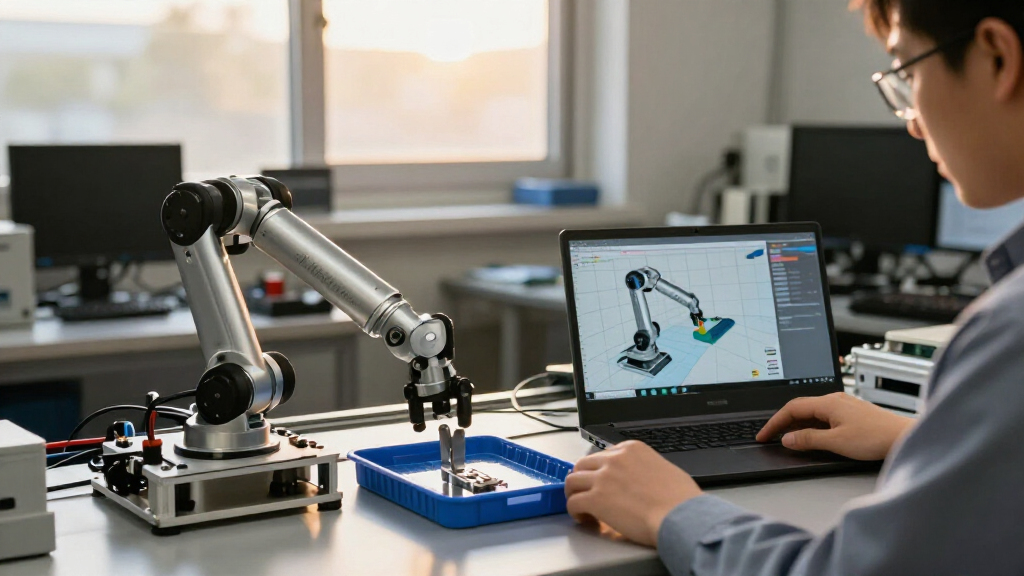
A Hugging Face walkthrough, detailed in the original analysis, demonstrates how to build a beverage-can pick-and-place simulation in Isaac Sim with a UR17G robot arm, a Robotiq 2F-140 gripper and a can asset from SimReady Central. The example shows how validated, reusable assets can provide a starting point, but it does not establish that the assembled task will work reliably: users must still configure the scene and controls, run the simulation and inspect the robot’s behavior.
The walkthrough brings together three asset packages: the UR17G arm, the Robotiq 2F-140 gripper and a beverage can. Their packages include models and simulation settings. For this example, those settings cover the robot and gripper joints, as well as the can’s collision geometry and mass. The guide says to download each complete asset folder, preserve its structure and use the local USD file paths when loading the assets into Isaac Sim.
Asset reuse does not assemble the task by itself. Users must compose the scene, connect the arm and gripper, position the robot, can and work surface, and provide controls for arm movement and gripper operation. Before attempting the pick, the walkthrough advises checking that the assets load without missing-file errors and inspecting settings in the loaded scene, since asset structures can vary.
The walkthrough says the arm’s validation report uses the Robot-Body 4.0.0 profile, while the gripper uses the Robot-Gripper 3.0.0 profile. Both reports pass PhysX driven-joint checks, which inspect joint-drive settings. Those checks concern specified asset requirements; they are not reported as tests of the entire pick-and-place sequence. The demonstration uses Isaac Sim 6.2 and describes enabling its remote Python server for an AI agent, while also allowing users to follow the documentation and set up the scene manually.
Build a robot pick-and-place simulation with SimReady assets
A Hugging Face walkthrough combines reusable assets in Isaac Sim. Profile checks offer a starting point, while the assembled task still needs to be run and inspected.
The example scene
Three assets form a beverage-can pick-and-place task.
UR17G
Its asset package includes the model and simulation settings for the arm joints.
Robotiq 2F-140
The gripper package includes settings for its joints.
Beverage can
The can asset includes collision and mass settings.
What validation checks
SimReady profiles specify requirements for assets prepared for a simulation use case.
| Asset | Profile | Reported check |
|---|---|---|
| UR17G arm | Robot-Body 4.0.0 | PhysX driven-joint check passed |
| Robotiq 2F-140 | Robot-Gripper 3.0.0 | PhysX driven-joint check passed |
Assemble the scene
The walkthrough uses Isaac Sim 6.2 and allows agent-assisted or manual setup.
Download all three packages, keep each complete folder intact, and load their USD files.
Compose the scene with the arm, gripper, can, and work surface.
Provide code for arm movement and gripper operation; check assets load without missing-file errors.
Run and inspect
Asset checks do not establish that the complete task will work reliably.
From Asset Checks to Task Tests
The example addresses a practical divide in simulation work: a robot model can have prepared settings and pass defined checks, yet still behave incorrectly when combined with a gripper, object, work surface and controller. Profile validation gives users evidence that particular requirements are met; it does not certify every interaction in a completed scene. That distinction matters to anyone relying on reusable assets to move from a model library to a testable robot task.
The walkthrough recommends checking joint limits and drive settings, trying small arm movements, opening and closing the gripper, and confirming that the can rests on the work surface. During the full task, users should observe whether the can remains held while the arm moves and whether it is released where intended. These are practical checks, not reported success metrics. The source provides no quantitative results for grasp success, repeatability or performance across runs, so it cannot show how reliably the demonstration works or how much time asset reuse saves.
An agent may help generate and run task code, potentially speeding up scene assembly. But generated code and outcomes can vary, the guide cautions, so users still need to inspect the code and verify the simulation. The practical takeaway is that prepared assets may reduce some setup work, while task-level testing remains necessary.
Products Worth Considering

Logitech MX Master 4 Ergonomic Wireless Mouse with Haptic Feedback, Graphite

Kindle Paperwhite Signature Edition 32GB E-Reader, 7-Inch Display, Seaglass Green

Jackery Solar Generator 1000 v2 with Two 100W Solar Panels, 1024Wh LiFePO4 Battery
As an affiliate, we earn on qualifying purchases.
How SimReady Profiles Work
The walkthrough describes SimReady as an OpenUSD asset prepared for a defined simulation use case. SimReady Foundation organizes its specifications into profiles, features and requirements: a profile groups features for a use case, features describe capabilities, and requirements set checks on asset settings. Validation checks whether an asset meets the requirements associated with its profile.
SimReady Central is described as an open library on Hugging Face for robot and object assets that include authored simulation properties and profile-validation evidence. The walkthrough also points to a USD Search endpoint for locating OEM-curated content. Its example uses GPT-6 Sol as the agent and says other agent and model combinations may work if they can load the required skills and execute Python against Isaac Sim. The source gives no publication date and frames the project as a build example, not a measured comparison of workflows.
“A robot can look visually correct while stationary in Isaac Sim but move or interact with objects incorrectly when the simulation runs.”
— Hugging Face walkthrough
What the Checks Do Not Show
The reported passing checks apply to specified requirements for the arm and gripper; the walkthrough does not show that every asset combination, controller or scene will behave reliably. It provides no grasp-success rate, repeatability data, run-to-run comparison or broader evaluation of the simulation workflow. The described checks also do not establish whether the can will be grasped, carried and released successfully in the completed scene.
The supplied material does not specify how the task controls are generated in detail, nor does it report an independently measured outcome for the demonstration. Asset settings may differ across packages, and code produced with an AI agent may vary. The walkthrough’s example should therefore be read as instructions for assembling and inspecting a simulation, not as evidence of validated performance across tasks.
Build and Test the Simulation
The next steps described are to download all three asset packages, load their USD files in Isaac Sim and compose the scene. Users then connect the robot and gripper, position the objects and work surface, and add or generate controls. With Isaac Sim 6.2, the example calls for enabling the remote Python server if using an agent; manual setup is also an option.
After confirming that files load correctly, users can test small movements and gripper actions before running the full pick-and-place sequence. They should inspect the grasp, transport and release, and review any generated code. The walkthrough provides no further milestone or publication date, so broader performance evidence remains unavailable in the supplied source.
Key Questions
What does the Isaac Sim example demonstrate?
It shows how to assemble a UR17G arm, Robotiq 2F-140 gripper and beverage-can asset into a pick-and-place simulation, then inspect the robot’s interactions with the can.
What do the passing validation reports confirm?
The walkthrough reports that the arm and gripper pass PhysX driven-joint checks for their stated profiles. These checks cover specified joint-drive requirements, not the success of the complete pick-and-place task.
Does the guide report a grasp-success rate?
No. The supplied material gives no quantitative results for grasp success, repeatability or performance across runs.
Can the scene be assembled without an AI agent?
Yes. The walkthrough describes using an agent connected to Isaac Sim, but also points users to documentation for manual scene setup.
What should users check during a run?
Users should confirm the assets load, test joint and gripper movement, and observe whether the can stays in the gripper as the arm moves and releases it as intended. Generated code and simulated behavior should be inspected, according to the walkthrough.
Primary source: Hugging Face · via ThorstenMeyerAI.com