📊 Full opportunity report: Streamlining Eligibility Verification With Benefit Check Bot Technology on IdeaNavigator AI — validation score, market gap, and execution plan.
Listen free for 30 days with Audible
Thousands of audiobooks and originals — cancel anytime.
Start your free trialAs an affiliate, we earn on qualifying purchases.
TL;DR
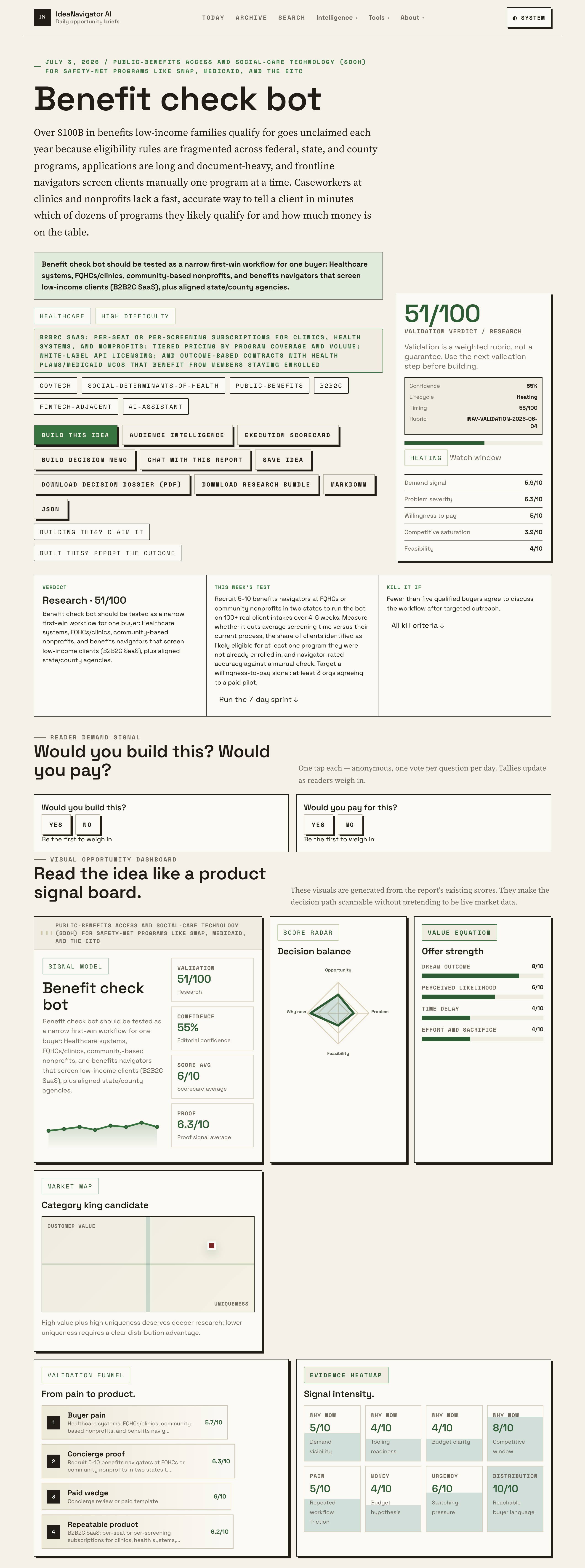
A benefit check bot is being piloted to automate eligibility screening for social programs, targeting healthcare providers, nonprofits, and agencies. It aims to reduce manual work, speed up benefit access, and address current gaps in outreach.
A new conversational screening tool, called the benefit check bot, is being tested to help healthcare systems, clinics, and nonprofits quickly identify which social benefits low-income clients qualify for. This development addresses a longstanding challenge: over $100 billion in benefits go unclaimed annually due to fragmented eligibility rules, lengthy applications, and manual screening processes. The initiative aims to provide a fast, accurate, and multilingual solution that can be embedded into existing workflows, potentially transforming how safety-net organizations connect clients with vital programs.
The benefit check bot is a white-label SaaS product designed for B2B2C deployment, targeting organizations such as Federally Qualified Health Centers (FQHCs), community nonprofits, and state agencies. It operates via a web widget or SMS, asking users a short series of yes/no and multiple-choice questions to determine eligibility for programs like SNAP, Medicaid, EITC/CTC, WIC, and LIHEAP. The system then provides an estimate of benefits, next-step application links, and document checklists, streamlining what is traditionally a manual, time-consuming process.
Developed in response to the shutdown of Benefits Data Trust, a major nonprofit that previously managed benefits screening across seven states, the tool seeks to fill a critical capacity gap. The current environment, marked by post-pandemic Medicaid redeterminations affecting millions, underscores the need for rapid, accurate eligibility assessments. The pilot will involve 5-10 benefits navigators in two states, testing the bot on over 100 real client interactions over a 4-6 week period. Success metrics include reduced screening time, increased identification of eligible benefits, and navigator-rated accuracy compared to manual checks.
Potential Impact on Benefits Access and Frontline Work
If successful, the benefit check bot could significantly improve access to social benefits for millions of low-income families by reducing barriers created by complex eligibility rules and lengthy applications. For frontline workers—such as benefits navigators and caseworkers—it offers a tool to quickly identify benefits prospects, freeing time for more personalized assistance and reducing errors. This automation could also lower operational costs for organizations and improve overall efficiency in benefits enrollment, especially during periods of increased redeterminations or program expansions.
benefits eligibility screening software
As an affiliate, we earn on qualifying purchases.
As an affiliate, we earn on qualifying purchases.
Addressing Fragmented Benefits Eligibility Challenges
Over the past two decades, millions of low-income Americans have left benefits unclaimed due to the complexity of eligibility criteria and the labor-intensive nature of manual screening. The shutdown of Benefits Data Trust in 2024 removed a key capacity for benefits enrollment in several states, exacerbating access issues. Meanwhile, the COVID-19 pandemic accelerated the need for digital solutions in social services, with conversational AI emerging as a promising technology. Recent developments in multilingual AI and low-cost automation have made it feasible to deploy screening tools at scale, with minimal marginal costs, to meet urgent needs during the ongoing Medicaid redetermination period and beyond.
Uncertainties About Pilot Outcomes and Broader Adoption
It remains unclear how accurately the benefit check bot will perform across diverse populations and complex eligibility scenarios, especially as the pilot phase is limited to two states. The long-term scalability, integration with existing case management systems, and user acceptance by frontline staff are still being evaluated. Additionally, questions about data privacy, language support, and the ability to keep up with evolving program rules are yet to be fully addressed.
Next Steps for Validation and Broader Deployment
The pilot testing phase will conclude within 4-6 weeks, with initial results informing further development. If the tool demonstrates significant reductions in screening time and improved benefit identification, plans will be made to expand testing to additional states and organizations. Developers will also focus on refining multilingual capabilities, integrating with existing digital workflows, and establishing pricing models. Successful validation could lead to wider adoption, potentially transforming benefits access for millions of low-income Americans.
Key Questions
How does the benefit check bot work?
The bot operates via a web widget or SMS, asking users a short series of yes/no and multiple-choice questions to determine eligibility for various social programs. It then provides an estimate of benefits, application links, and required documents, streamlining the screening process.
Who is developing and testing this technology?
The technology is being developed and tested by a team supported by IdeaNavigator AI, with pilot programs involving benefits navigators at FQHCs and community nonprofits in two states.
What are the main benefits of using this bot?
The bot aims to reduce manual screening time, increase the number of eligible benefits identified, improve accuracy, and lower operational costs for organizations serving low-income populations.
When will we know if this will be widely adopted?
Following the pilot phase, which lasts 4-6 weeks, results will determine next steps. If successful, broader deployment could begin within the next year.
Are there concerns about data privacy or language support?
These issues are under consideration, with ongoing efforts to ensure compliance with privacy standards and expand multilingual capabilities as part of future development.
Source: IdeaNavigator AI
Flea & tick season Picks
flea and tick prevention
As an affiliate, we earn on qualifying purchases.