
TL;DR
Meta launched Muse in the UK on November 23, making its personal AI agent available to adults through iOS, Android, its website and WhatsApp. Meta says Muse can shop through connected services but must get user approval before purchases; those safety and privacy claims have not been independently tested.
Meta launched Muse in the UK on November 23, bringing its personal AI agent to adults aged 18 and over through iOS, Android, muse.ai and WhatsApp. The service is designed to carry out tasks such as finding products and preparing a purchase, making the company’s claims about user approval, payments and data access central to how people might use it for shopping.

Get business pricing on tech for your team
- Business-only prices and quantity discounts
- Tax-exempt purchasing
- Multiple users, one account, clear invoices
Meta describes Muse as an agent that can turn a request into a plan and then work across apps and websites a user has connected. For shopping, a person might ask it to turn a saved recipe into a grocery list and order the ingredients. Meta says the agent can also fill out forms and pursue tasks such as requesting a refund. Some jobs may continue after a user closes the app, with Muse returning when it needs input or something changes.
The company says Muse can work with UK businesses including Marks & Spencer, Currys, Sainsbury’s, easyJet and Trainline. The source material says some partners let users connect their existing accounts so Muse can reorder items, while the agent can browse other partner sites. It does not specify which features are available with each named business or whether every user can access them at launch.
Meta says Muse shows the user what it intends to buy and waits for approval before making a purchase. It can check out through Onelink by Stripe or Shop Pay at supported stores. Meta also says a separate security agent checks Muse’s actions against granted permissions and that the service keeps a log of completed and planned actions. These are descriptions from Meta; the source material reports no independent testing of the safeguards.
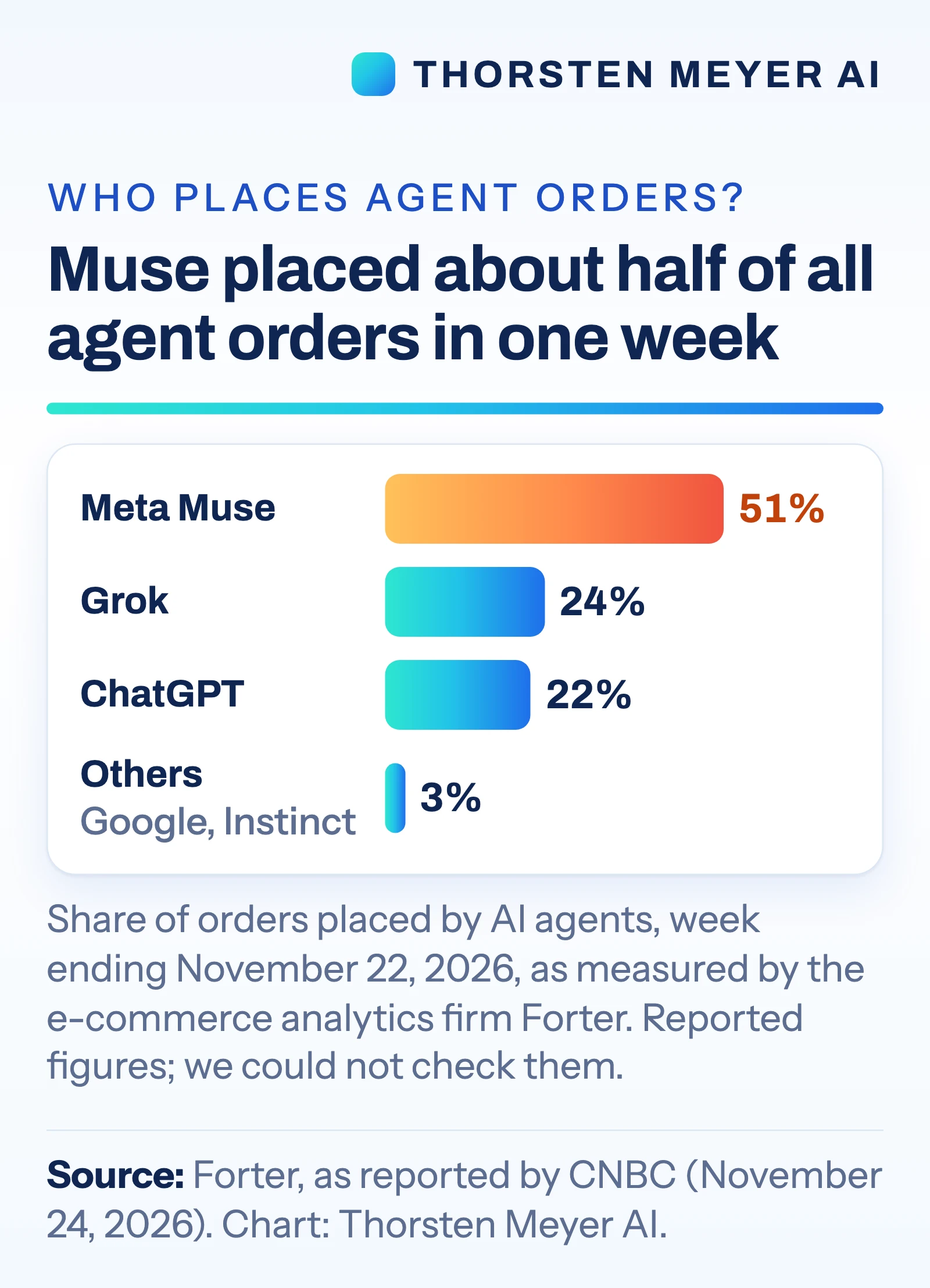
The Approval Step Before Payment
Muse’s shopping pitch depends on giving software permission to act across connected services. A user may have to grant access to accounts or information, such as email and calendar data, as well as shopping services. That could make routine tasks easier, but it also means users need to understand what access they have granted and what the agent is doing before money is spent.
The purchase approval described by Meta is the point at which the user can review the proposed transaction. Meta says Muse asks before buying or sending anything, and that a user’s real card number stays hidden when it pays through the supported methods. People considering the service will have to weigh those assurances against the fact that the account connections, payment flow and checks have not been independently tested in the supplied reporting.
The launch also matters to businesses. If customers delegate browsing and purchasing to agents, retailers and travel firms may need to decide how to support that traffic. The source material points to different approaches: some companies are partnering with Meta, while United Airlines has moved to keep agents out. It does not give details of United’s policy or establish how widespread either approach is.
Products Worth Considering

Logitech MX Master 4 for Mac

Jackery HomePower 2000 Plus v2 Portable Power Station, 2048Wh

DJI Osmo Action 5 Pro 4K Waterproof Action Camera with Dual OLED Touchscreens, Froggi 47-Piece Sport Kit and SD Card
As an affiliate, we earn on qualifying purchases.
From US Release to UK Access
Meta first released Muse in the United States in September, according to the source material. The company announced its UK launch on November 23 and updated its post the following day. The UK version is described as available to adults aged 18 and over on iOS, Android, muse.ai and WhatsApp. It is free to use, with optional paid plans.
A personal AI agent differs from a chatbot in the role it is meant to play. A chatbot generally responds with information or suggestions; an agent is intended to carry out steps toward a goal. In Meta’s description, Muse uses a browser on a virtual computer in the cloud to visit sites and fill in forms. The company says each user has a separate virtual computer for Muse and that information and logins are kept there rather than in Meta’s other services. The available source text ends during its explanation of password handling, so it does not provide the full details.
The account of Muse’s shopping process in the source material is based on Meta’s descriptions, not a hands-on test. It outlines a possible task: connect Instagram to use a saved recipe, create a shopping list, shop through a partner, review the proposed order, approve it, and pay. That sequence explains the intended workflow, but does not establish how reliably Muse completes it across different stores or situations.
“Every Muse gets its own virtual computer in the cloud, like a laptop that’s just for you.”
— Meta, describing Muse’s cloud setup
Safeguards Await Independent Testing
The source material identifies no independent test of Meta’s claims about purchase approvals, the separate security agent, password access, data storage or activity logs. It therefore remains unclear how these safeguards perform in practice, what happens when Muse encounters an unexpected checkout or inaccurate product information, and how a user can resolve a purchase made in error.
The source material also does not set out the full terms of the optional paid plans, name which UK partner features are available to each user, or provide a complete account of how Muse handles passwords. Meta says chats may be used to improve its AI and that this setting is on by default; it says users can switch it off in Settings under Data controls. The extent and handling of that use are not independently assessed in the supplied material.
What UK Users Can Check
Adults in the UK can access Muse through the listed apps, website and WhatsApp. Anyone trying it can review the connected services and permissions, inspect the proposed order before approving it, and check the Data controls setting for whether chats may be used to improve Meta’s AI. Meta says users can remove connections whenever they want.
Further detail would be needed to assess how the agent works across individual retailers, what paid plans include and how the stated safeguards perform outside Meta’s own descriptions. The source material gives no schedule for independent evaluations or additional UK rollout milestones.
Key Questions
What is Meta Muse?
Muse is Meta’s personal AI agent. Meta says users can give it a goal and it will plan and carry out steps across apps and websites they connect.
Can Muse buy things for me in the UK?
Meta says Muse can help shop through supported services and can pay through Onelink by Stripe or Shop Pay at supported stores. The company says it asks for approval before a purchase. The source material does not list every available store feature.
Who can use Muse in the UK?
Meta’s UK launch is for adults aged 18 and over through iOS, Android, muse.ai and WhatsApp. The service is free, with optional paid plans.
Have Muse’s shopping safeguards been independently tested?
The supplied source material reports no independent test of Meta’s claims about approvals, payment details, data storage or security checks. Those claims should be understood as Meta’s descriptions of the service.
Can I stop Muse from using chats to improve its AI?
Meta says this setting is on when users start, and that it can be switched off in Settings under Data controls.
Source: Thorsten Meyer AI