
🔍 Read the full analysis: Farming In The AI Era: What’s Changing? on ThorstenMeyerAI.com

Get business pricing on tech for your team
- Business-only prices and quantity discounts
- Tax-exempt purchasing
- Multiple users, one account, clear invoices
TL;DR
Agricultural automation is advancing unevenly: satellite guidance is widespread across acres of several major U.S. crops, and robotic milking is used on some German dairy farms. But USDA data show only 22% of U.S. farms reported using any precision farming practice in 2025, while strawberries and other delicate crops still rely heavily on hand labor.
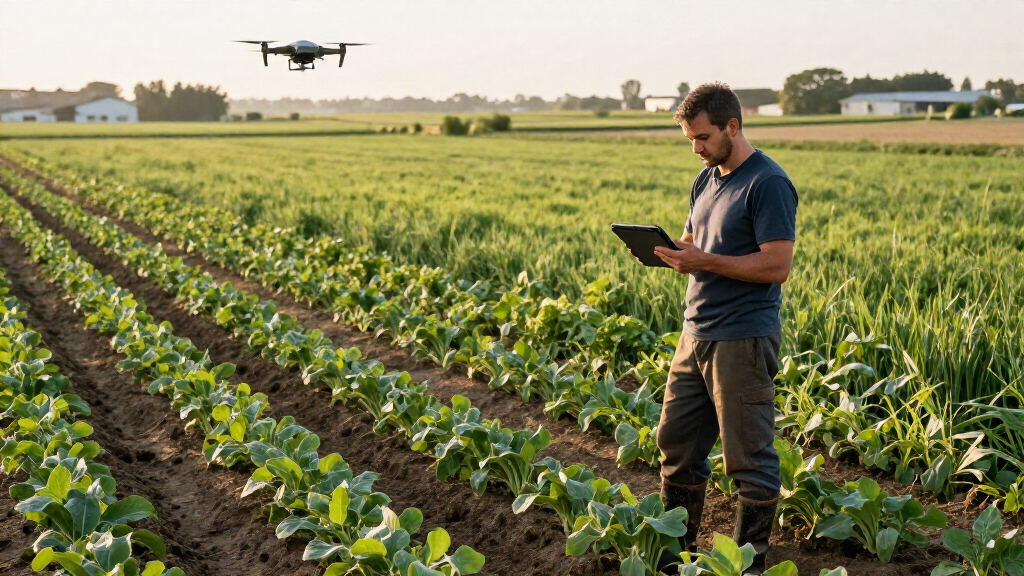
Farm automation is advancing unevenly: satellite guidance steers machinery across large areas of several major U.S. crops, and robots milk cows on some German dairy farms, but delicate fruit harvesting still depends heavily on people. A November 29 report from ThorstenMeyerAI.com uses agriculture to examine which farm tasks technology can take over—and which remain hard to automate.
U.S. Department of Agriculture data show guidance systems were used on more than half of the planted acres of corn, soybeans, winter wheat and cotton in the most recent crop-year figures cited in the report, which range from 2016 to 2019. For corn, the share rose from 5.3% of planted acres in 2001 to 58% in 2016. The measure is acreage, not the proportion of farms using the technology.
The distinction matters: USDA survey results show 22% of U.S. farms used any precision farming practice in 2025, down from 27% in 2023. The category includes practices such as GPS guidance, yield monitoring, soil mapping, variable-rate applications, drones, electronic tagging, precision feeding and robotic milking. Larger farms are more likely to adopt guidance: in 2016, 73% of the largest corn farms in the cited data used it, compared with 10% of the smallest.
In livestock operations, Destatis, Germany’s federal statistics office, counted 8,800 dairy farms with automatic milking systems in 2023, or 19% of the country’s dairy farms. Harvesting soft fruit remains a harder case. The report cites a 2024 University of California cost study finding that harvest accounted for about two-thirds of costs for organic strawberries. It also cites a 2014 review of 50 harvesting robots, which reported an average success rate of 66% and 33 seconds per fruit; the review found none on the market at the time. The report says commercial strawberry robots now operate on table-top systems, rather than in soil-grown fields.
Infographic 01 · Precision farming
Most acres, not most farms
Satellite steering took over most of America’s big crop fields, but only about one US farm in five uses any precision farming. The big farms adopt first.
US corn · share of planted acres with auto-steer (ERS, ARMS)
Guidance systems by 2019 · share of planted acres (ERS)
US farms using any precision agriculture practice · share of farms (NASS)
US corn farms using guidance, 2016 · by farm size (ERS)
Germany, 2023 · dairy farms with milking robots (Destatis)
Acre shares (ERS, by crop and survey year) and farm shares (NASS) are different measures and not directly comparable. Before 2018, ERS “guidance” means auto-steer without lightbars. NASS counts GPS guidance, yield monitoring, soil mapping, variable rate, drones, electronic tagging, precision feeding and robotic milking.
Sources: USDA ERS, EIB-248 (2023); USDA ERS, Amber Waves (April 2023); USDA NASS, Technology Use (August 2025); Destatis press release 204 (23 May 2024).
Powered by Thorsten Meyer AI
Why Fieldwork Is Hard to Automate
The contrast shows why automation does not spread evenly across agriculture. Guidance systems work over large, open fields and can take on a repeatable driving task. A harvesting robot must locate individual fruit, judge whether it is ripe, reach it without damage and handle it at a workable speed. Variations in plant shape, weather and crop layout add further challenges. In strawberries, the high labor share of production costs gives growers a reason to seek alternatives, but a machine must also perform reliably and economically under real growing conditions.
Adoption figures also affect how farm technology should be described. Saying that “farms are automated” can obscure the gap between a technology covering many acres and being used by a smaller share of farms. The report attributes part of that gap to farm size: larger operations can spread the cost of equipment over more land. Smaller farms may face different economics and practical barriers.
The work has consequences beyond machinery purchases. The U.S. Department of Labor certified 398,258 temporary H-2A farm jobs in fiscal 2025, compared with just over 48,000 in fiscal 2005, according to figures cited in the report. These are certifications, not a count of all agricultural workers or proof that automation caused the change. They underline that seasonal labor remains a major part of the U.S. farm workforce even as some tasks become mechanized.
Products Worth Considering

Jackery Explorer 1000 v2 Portable Power Station

Apple iPad mini (A17 Pro) 128GB Wi-Fi 6E – Starlight

Logitech MX Mechanical Wireless Illuminated Keyboard, Tactile Quiet, Graphite
As an affiliate, we earn on qualifying purchases.
From GPS Guidance to Robotic Milking
The report traces precision farming’s growth to equipment and positioning systems developed over several decades. USDA’s Economic Research Service says yield monitors reached the market in 1993, followed by yield and soil maps and, in 1995, variable-rate technology that adjusts inputs such as seed or fertilizer across a field. Guidance aids appeared in the mid-1990s, with automatic steering arriving later that decade.
A change to civilian GPS also helped. On May 1, 2000, the U.S. government ended Selective Availability, which had deliberately reduced the precision of civilian GPS signals. Farm operators could then use satellite positioning more accurately. USDA figures cited in the report show guidance adoption increasing over time, though the crop-acre statistics come from different years and should not be read as a single-year snapshot.
Robotic milking followed a separate path. Dutch dairy-equipment maker Lely says it installed a prototype of its Astronaut system on two farms in 1992 and launched it commercially in 1995. In such systems, a cow enters a milking station, sensors locate the teats and a robot arm attaches the milking cups. Destatis’ 2023 figures provide a later measure of adoption in Germany, not a global estimate.
“Most acres, not most farms.”
— ThorstenMeyerAI.com report, November 29, 2026
How Far Will Harvest Robots Spread?
The cited figures do not establish how many farm jobs have been replaced by machines, or whether precision technology has reduced total labor demand. The H-2A certification count measures approved temporary job certifications, and the report does not link its increase to automation. The 22% USDA figure covers a broad set of precision practices, so it does not indicate how many farms use AI specifically.
The report provides no current, comparable measure of commercial strawberry-robot performance, cost or acreage. The 2014 review describes systems available at that time; it cannot establish how today’s commercial machines perform. The date and scope of the cited table-top deployments are also not detailed enough to show how broadly they are used. Results will depend on crop, farm size, labor costs, equipment prices and whether machines can work reliably in field conditions.
The Next Test Is Field Economics
The next measure to watch is not simply whether a harvesting robot can pick fruit, but whether it can do so at a pace, cost and level of reliability that growers can use across a commercial season. Updated field trials and adoption data would help compare robots with hand harvesting and clarify which crops and growing systems are suited to automation.
Future USDA surveys can also show whether the share of farms using precision practices changes after the 2025 reading. For now, the evidence supports a task-by-task picture: guidance systems and robotic milking are established technologies with measurable use, while automated strawberry picking remains less widely documented. How that balance changes will depend on technical performance and farm economics, not on the label “AI” alone.
Key Questions
How many U.S. farms used precision agriculture in 2025?
Twenty-two percent of U.S. farms reported using at least one precision farming practice in 2025, according to USDA survey data cited by the report. The category includes several technologies and does not measure AI use alone.
Does satellite guidance cover most U.S. farms?
Not according to the figures cited. Guidance systems were used on more than half of the planted acres of several major crops in the cited crop-year data, but the 2025 USDA survey found that 22% of farms used any precision practice. Acreage coverage and farm adoption are different measures.
Are robots already harvesting strawberries commercially?
The report says the first commercial strawberry robots are operating on table-top systems, but it does not provide a current deployment count or performance comparison. The cited 2014 review predates those reported commercial uses.
How common is robotic milking in Germany?
Destatis counted 8,800 German dairy farms with automatic milking systems in 2023, equal to 19% of the country’s dairy farms.
Do the figures show that farm automation is reducing jobs?
No. The figures describe technology use and H-2A job certifications, but they do not establish that automation caused a change in employment. The report says seasonal farm labor remains significant while some farm tasks are mechanized.
Source: ThorstenMeyerAI.com