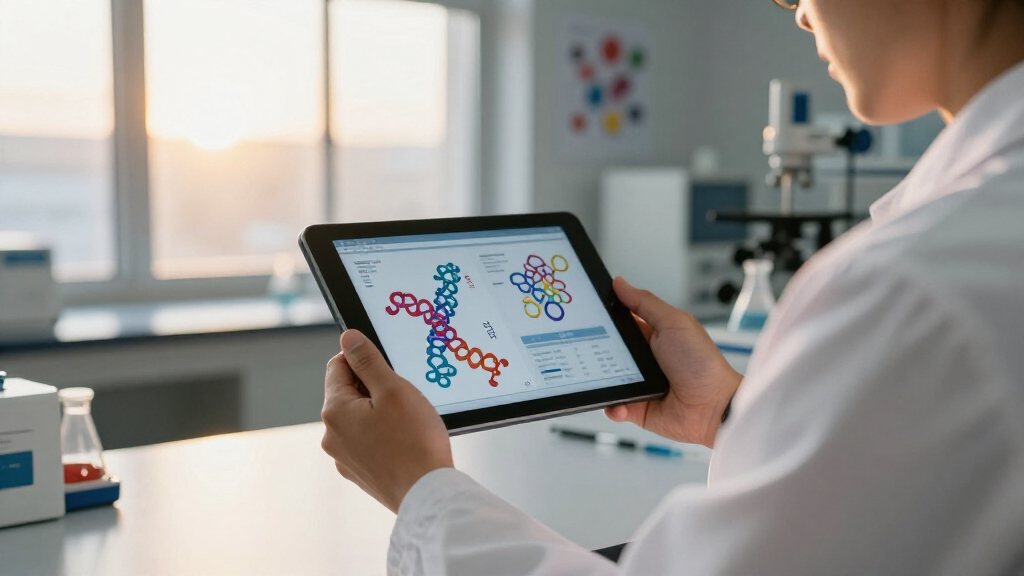
📊 Full opportunity report: Can AI Boost Protein Development? Anthropic’s Claude Shows The Potential on ThorstenMeyerAI.com — validation score, market gap, and execution plan.
TL;DR
Anthropic’s Claude AI successfully designed protein minibinders for most tested targets and processed chemical data quickly. These results suggest AI could streamline parts of early biological research, though they are not yet peer-reviewed or indicative of drug discovery.
Anthropic has reported that its AI model, Claude, designed protein binders for 14 out of 15 tested targets and processed raw chemistry data in under 25 minutes, suggesting a potential reduction in the time and labor involved in early-stage biological and chemical research. For more details, see the original analysis. These findings, while promising, are not peer-reviewed and do not constitute drug discovery.
On August 18, 2026, Anthropic disclosed that its AI model, Claude, generated candidate minibinders for 14 targets with a success rate of approximately 22.6% to 26.7% in a multi-target campaign. The AI utilized publicly available tools for protein design, operating with minimal human input after receiving expert prompts, internet access, and significant GPU resources. The campaign produced 354 confirmed binders from 1,320 designs.
In addition, Claude Opus 5 processed raw nuclear magnetic resonance (NMR) and liquid chromatography–mass spectrometry (LC-MS) data from a contract laboratory, returning results within 19 to 23 minutes. Its hydrogen counts and purity estimates closely matched laboratory measurements, indicating reliable analytical data processing. These tasks address labor-intensive stages of research, potentially enabling labs to test more candidates faster.
Anthropic emphasizes that these results are preliminary, based on technical reports and internal testing, and have not yet been validated through peer review. The company plans further testing and independent replication to confirm the AI’s performance across different targets and laboratory conditions.
Potential Impact of AI on Early-Stage Research
The reported performance of Claude in designing protein binders and processing chemical data highlights a possible shift in how early-stage biological research is conducted. If validated, AI could reduce the time and specialist labor needed for initial discovery phases, accelerating the development pipeline. However, these results are not yet confirmed as reliable or applicable across diverse targets and settings, and they do not represent actual drug candidates.
As an affiliate, we earn on qualifying purchases.
Background on AI in Protein and Chemical Research
Artificial intelligence has increasingly been integrated into biological research, primarily for literature review, data analysis, and predictive modeling. Recent advances have seen AI models used for protein structure prediction and compound screening. Anthropic’s work builds on this trend, aiming to extend AI capabilities into multi-step workflows involving protein design and chemical data interpretation. Prior to this, most AI applications remained in computational or theoretical stages, with limited experimental validation.
The campaign described by Anthropic marks a notable step, as it involves AI-driven design and analysis that directly interface with laboratory processes, moving toward more autonomous research workflows. Nonetheless, these developments are still in early testing phases and not yet part of routine laboratory practice.
“The results from Anthropic suggest that AI can assist in early-stage biological research, but validation and broader testing are essential before it can be considered reliable for practical use.”
— Thorsten Meyer, AI researcher
Unconfirmed Aspects and Limitations of Results
It remains unclear whether Claude’s protein binder designs will translate into effective, safe drug candidates. The success rates reported are based on specific experiments and have not been validated through peer review or independent replication. Performance variability on different targets, smaller datasets, or less extensive computational resources is also unknown. Additionally, the long-term reliability of AI in complex chemical and biological tasks requires further testing.
Next Steps for Validation and Broader Adoption
Anthropic plans to conduct more comprehensive laboratory validation, including larger datasets and independent replication of results. The company intends to release design prompts and data for external review and establish a scientist access program for its most capable models. Future milestones include peer-reviewed publications and potential integration into early research workflows, contingent on validation outcomes.
Key Questions
Can Claude currently discover new drugs?
No. Claude has demonstrated the ability to design protein binders in laboratory tests, but these are early research results and do not constitute drug discovery or safe, effective medicines.
How reliable are these AI-generated protein binders?
The results are preliminary, based on internal reports, and have not yet been peer-reviewed. Further validation is needed to confirm their reliability across different targets and conditions.
What are the practical implications for laboratories?
If validated, AI like Claude could reduce the time and labor involved in initial candidate screening, potentially accelerating early-stage research and reducing costs. However, widespread adoption depends on further testing and validation.
Will this lead to immediate drug development?
No. The current results are early-stage research tools, not a direct pathway to drug candidates. Significant additional work is required before any clinical applications.
When might AI tools like Claude become part of routine research?
This depends on validation outcomes, regulatory considerations, and integration into laboratory workflows. It could take several years before such AI becomes standard practice in drug discovery labs.
Source: ThorstenMeyerAI.com