
It’s a coincidence that many people are unaware of how they can prove something is true without revealing the secret itself. Zero-knowledge proofs make this possible, allowing you to demonstrate knowledge securely and privately. If you’ve ever wondered how this works in technology like blockchain or digital IDs, there’s more to uncover. Understanding this concept can change how you see privacy and security in the digital world.
Key Takeaways
- Zero-knowledge proofs let someone confirm they know a secret without revealing it.
- They work by convincing a verifier of a statement’s truth without sharing any additional information.
- The process relies on complex math assumptions that make cheating or false claims difficult.
- Used in privacy-focused technologies like secure transactions and digital identity verification.
- They help prove knowledge or facts securely while keeping sensitive details private.
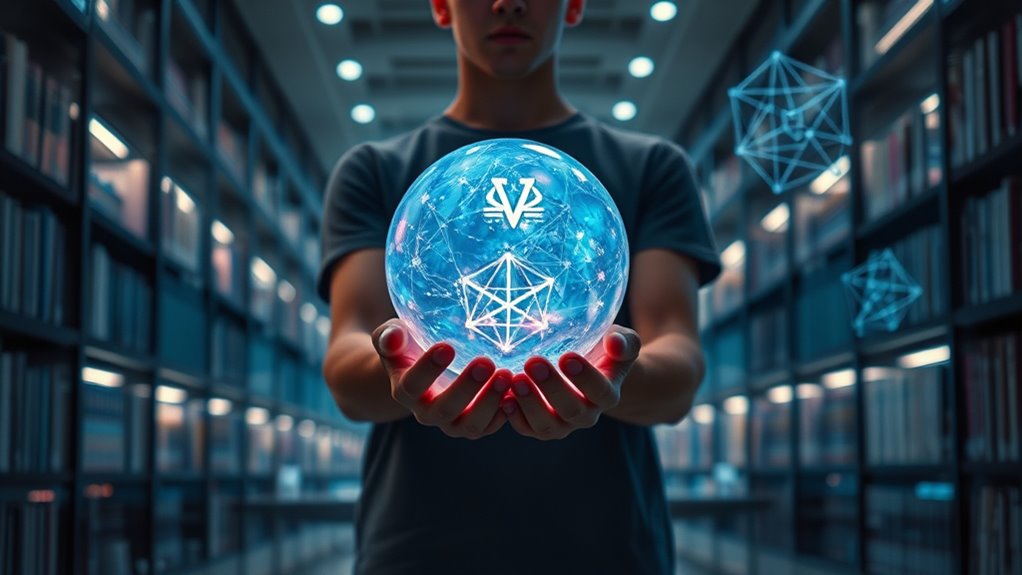
Have you ever wondered how you can prove something is true without revealing any details? That’s the core idea behind zero-knowledge proofs. These cryptographic methods let you convince someone else that a statement is correct without giving away any secret information. Imagine you know a passcode, but you don’t want to reveal it. With a zero-knowledge proof, you can demonstrate that you know the passcode without ever showing it. This concept might sound like magic, but it’s actually based on rigorous mathematical principles.
The key properties of zero-knowledge proofs ensure they work as intended. First, completeness guarantees that if the statement is true, a honest prover can convince a verifier. Second, soundness makes sure that false statements can’t be convincingly proven. Third, the zero-knowledge property ensures that the verifier learns nothing beyond the fact that the statement is true. This combination keeps your secrets safe while still proving your knowledge. The security of zero-knowledge proofs relies on complex cryptographic assumptions, which ensure they are resistant to forgery or deception. Additionally, the effectiveness of these proofs depends on computational hardness assumptions, which underpin their security.
Zero-knowledge proofs can be either interactive or non-interactive. Interactive proofs involve a back-and-forth exchange, where the verifier challenges the prover, who responds with evidence. Non-interactive proofs are more streamlined, allowing the proof to be verified without multiple interactions. This flexibility makes zero-knowledge proofs suitable for many applications. For example, in blockchain systems, they enable privacy-preserving transactions. You can prove ownership of a cryptocurrency without revealing details of your transactions. Similarly, they’re used in secure data sharing, voting systems, and digital identity verification—allowing you to prove something about yourself without exposing sensitive information.
There are various ways to implement zero-knowledge proofs. They can demonstrate complex facts, like the fact that a graph is 3-colorable, without revealing the coloring itself. Or they can prove that you know a specific discrete logarithm without revealing it. In cryptocurrency, they help prove ownership or transaction validity while keeping details private. The process involves sophisticated cryptographic techniques, such as homomorphic encryption, and aims to minimize computational overhead. Researchers continually work on reducing the chances of errors in proofs and increasing efficiency to make these methods more practical for everyday use.
Despite their many benefits, zero-knowledge proofs aren’t without challenges. They can be complex to develop and understand, and scaling them up for large, real-world applications remains difficult. However, ongoing research aims to overcome these hurdles. As technology advances, zero-knowledge proofs are expected to become more widespread, enhancing privacy and security across digital platforms. Ultimately, they offer a powerful way to prove your knowledge without exposing your secrets, making them a essential tool in the future of secure communication and data privacy. [Their reliance on advanced cryptography ensures robust security but also requires careful implementation to prevent vulnerabilities.

TP-Link 𝗧𝗮𝗽𝗼 Smart Plug Wi-Fi Mini, Energy Monitoring, Compatible with Alexa & Google Home & Samsung SmartThings, Timer, 15A/1800W Max, ETL Certified, 2.4G Wi-Fi Only, Tapo P115(2-Pack)
【Insightful Energy Tracking】Track your plug's energy use with clear and easy-to-understand statistics and intuitive charts, helping you optimize...
As an affiliate, we earn on qualifying purchases.
Conclusion
Now that you get the basics, think of zero-knowledge proofs as your secret handshake—showing you’re in the club without revealing the secret. With this tech, you can prove you know something important without giving away the details, just like a modern-day Sherlock using a secret code. It’s like having a magic cloak that keeps your secrets safe while still proving you’re trustworthy. So, embrace this digital wizardry—it’s the future of privacy, straight out of a sci-fi novel!

Emporia Energy Monitoring Smart Plug, WiFi Smart Outlet Plug Works with Alexa and Google Home - 15a WiFi Outlet with Timer, Mobile App, Home Energy Monitor, Scheduling - 2.4ghz WiFi Only (4 Pack)
Control Your Appliances and Devices: Control lights, fans, lamps, humidifiers, and any other appliances or electronics that plug...
As an affiliate, we earn on qualifying purchases.
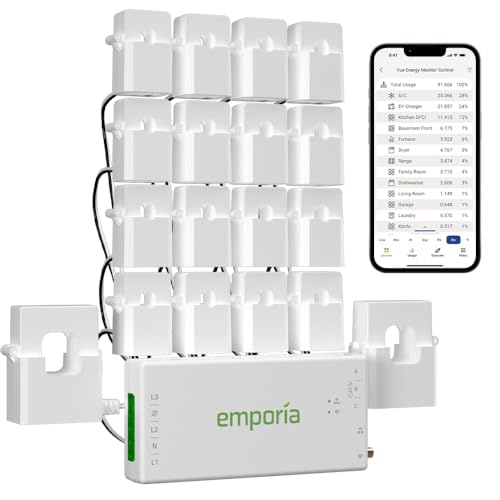
Emporia Vue 3 Home Energy Monitor - Smart Home Automation Module and Real Time Electricity Usage Monitor, Power Consumption Meter, Solar and Net Metering for UL Certified Safe Energy Monitoring
SAFETY YOU CAN TRUST WITH UL CERTIFICATION: With Emporia Energy, your home energy monitoring is safe, reliable, and...
As an affiliate, we earn on qualifying purchases.

Smart Home Energy Monitor, Measure Power Usage in Real-Time, History with App (2 200A Circuit Level Sensors) - Compatible with Home Assistant
EASY INSTALLATION: Installs in circuit panel of most homes with clamp-on sensors. Supports single-phase up to 240VAC line-neutral;...
As an affiliate, we earn on qualifying purchases.