
TL;DR
Large language models turn prompts into tokens and numbers, process them through transformer layers, then select and generate one token at a time. Training and, for some models, extra reasoning steps shape the responses, but the process can still produce errors and does not guarantee factual accuracy.
The process starts by splitting a prompt into tokens, which can represent a character, part of a word, a whole word or punctuation. OpenAI’s guidance gives a rough English estimate of four characters per token, or about three-quarters of a word, while stressing that these are estimates. The exact count depends on the model and its tokenizer. The explainer says tokens also set units for usage costs and input limits.

Get business pricing on tech for your team
- Business-only prices and quantity discounts
- Tax-exempt purchasing
- Multiple users, one account, clear invoices
Each token is converted into a list of learned numbers called an embedding. A transformer then processes the representations through layers that use attention to relate tokens to one another. The model assigns probabilities to possible next tokens; a sampling method selects one, adds it to the sequence, and the model repeats the process. That is why answers appear piece by piece and why the same prompt can produce different wording.
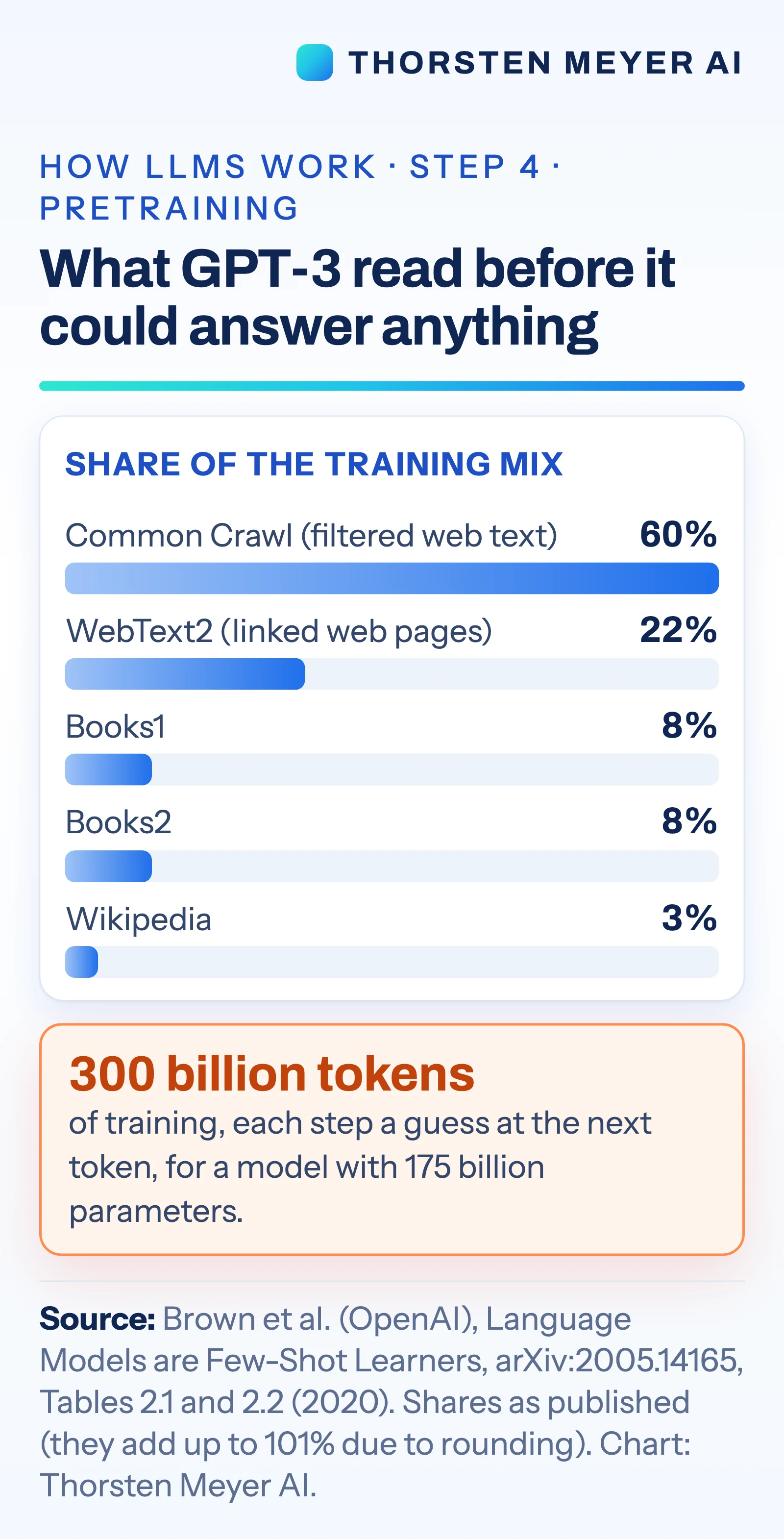
The explainer distinguishes pretraining, in which a model learns to continue text from a large corpus, from post-training intended to make it follow instructions. It describes approaches that use human feedback or AI feedback guided by written principles. Some reasoning models also spend additional computation generating hidden reasoning tokens before presenting an answer; the source says those tokens count as output for billing. The guide cautions that the underlying process can produce plausible but incorrect answers.
Why Prediction Shapes Trust
Understanding that a model predicts text helps explain both its usefulness and its limits. It can produce coherent responses from patterns learned during training, but that fluency alone does not establish that a statement is accurate. The source notes that models can make things up and may lack information about events after their training data ends.
For workplace use, the practical implication is to treat answers as generated material that may need checking, especially when decisions depend on factual precision. Token limits and per-token costs also affect how much information a user can submit and what it costs to generate longer responses. The explainer frames verification as part of using the tool responsibly.
Products Worth Considering

Samsung 27-Inch Odyssey G5 QHD Gaming Monitor (G51F)

Bose SoundLink Max Portable Bluetooth Speaker, Black

Apple AirPods Pro (2nd Generation) Wireless Earbuds with USB-C MagSafe Charging Case
As an affiliate, we earn on qualifying purchases.
From Text Prediction to Assistants
The transformer architecture described in the explainer was introduced in the 2017 paper Attention Is All You Need. Attention lets a model weigh relationships among tokens in the input while processing it. The article also references earlier research on representing rare words as sequences of subword units, a method that helps tokenizers handle unfamiliar names and terms.
Raw next-token prediction does not by itself explain why a chatbot follows requests or adopts an assistant-like style. The source says models are further trained using human feedback or AI feedback shaped by written principles. It cites an OpenAI 2022 study reporting that a 1.3 billion parameter model trained with human feedback was preferred to the 175 billion parameter GPT-3 in that study. That comparison is specific to the reported evaluation and does not establish a general rule that smaller models are better.
“The model never looks up an answer. It turns text into numbers, predicts the next token, picks one, adds it to the text and starts again.”
— Thorsten Meyer AI explainer
Where the Account Has Limits
The source gives a general account rather than a technical specification for every model. Tokenization, training methods, reasoning behavior, costs and available tools vary by system. Its token-size estimates are approximate, and the visual examples are described as illustrative.
The explainer does not establish how often a given model will make factual errors, how reliably hidden reasoning improves results, or whether a particular response reflects accurate information. It also does not provide a single cutoff date for all models’ training data. Those details depend on the model and the question being asked.
Checking Answers in Practice
The explainer points readers to related guides on neural network arithmetic, deep learning and context windows for more detail on individual parts of the process. For users applying chatbots to work, the next step is to check important claims against reliable sources and account for the model’s limits, token usage and available context.
The article does not identify a later announcement or technical milestone. Its practical conclusion is that a generated response should be evaluated on its evidence and fit for the task, rather than accepted solely because it reads confidently.
Key Questions
Does an LLM retrieve a ready-made answer?
In the process described by the explainer, the model predicts and generates tokens in sequence. This account does not mean that no chatbot can use search or other tools; those capabilities depend on the system.
What is a token?
A token is a piece of text processed by a model. It may be a character, part of a word, a whole word or punctuation. Token counts vary by model and text.
Why can the same prompt get different answers?
The model scores possible next tokens and a sampling method selects among them. Settings such as temperature affect how adventurous those selections are, so wording can vary.
Can a fluent answer still be wrong?
Yes. The explainer says models can make things up. Fluency reflects generated text and is not, by itself, proof that a claim has been checked.
What do reasoning models add?
According to the source, some reasoning models use additional computation and generate hidden reasoning tokens before answering. The explainer says those tokens count as output tokens for billing, but does not quantify how reliably they improve answers.
Source: Thorsten Meyer AI