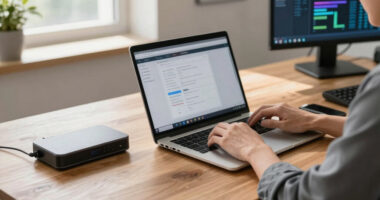
🔍 Read the full analysis: Why This 6-Bay UGREEN NASync DXP6800 Pro Suits Our AI Setup on ThorstenMeyerAI.com

Get business pricing on tech for your team
- Business-only prices and quantity discounts
- Tax-exempt purchasing
- Multiple users, one account, clear invoices
TL;DR
Thorsten Meyer’s small AI and publishing operation bought a six-bay UGREEN NASync DXP6800 Pro after duplicate iCloud backup files nearly filled a server. The NAS has four 16 TB hard drives and an NVMe SSD, but as of November 1, 2026, it is not installed and its planned backup setup has not passed acceptance tests.
Thorsten Meyer’s AI and publishing operation has bought a six-bay UGREEN NASync DXP6800 Pro after duplicate files from an iCloud-synced backup nearly filled a database server. The NAS has been delivered with four 16 TB hard drives and an NVMe SSD, but it is not yet connected or configured; the planned backup system remains untested.
Meyer said that on September 17, a server fell to 2% free disk space after two machines uploaded database dumps with the same file name to an iCloud folder. The service retained repeated conflict copies, producing 29 duplicates. A separate backup-cleanup job also timed out on October 29 while trying to remove old copies. These events led Meyer to stop relying on a sync folder as the primary backup destination.
The operation’s measured storage use on October 6 was about 2.6 TB on the main desk machine, 744 GB on the database server and 3.2 TB on the model server. Meyer estimates the immediate backup need at 6 to 8 TB. The NAS is intended to provide a local destination for backups and a separate place to run containers and test databases, rather than keep those workloads on a laptop.
The planned configuration uses four Seagate IronWolf Pro 16 TB drives in RAID 6, which Meyer estimates would provide about 32 TB of usable capacity, alongside the NVMe SSD as a separate pool. The proposed safeguards include separate non-admin accounts and quotas for Mac backups, daily snapshots inaccessible to those accounts, and an encrypted offsite copy sent with restic to Backblaze B2 with Object Lock. Those are plans, not verified results. Meyer disclosed that he paid for the NAS and drives, received no sample or sponsorship from UGREEN, and included no affiliate links.
Infographic 01 · The box
Six bays, two fast slots, two 10GbE ports
What UGREEN lists for the NASync DXP6800 Pro, and how we plan to fill it.
How we fill it
Delivered and equipped; the setup is our plan (1 Nov 2026)
Bays 1–4: Seagate IronWolf Pro 16 TB, RAID 6, Btrfs → ≈ 32 TB usable, any two drives may fail. Bays 5–6: free for growth. M.2 slot 1: the NVMe SSD (ordered: Samsung 990 Pro 1 TB) as its own fast pool. Slot 2: free. Six 16 TB drives in RAID 6 would give ≈ 64 TB.
What else UGREEN lists
From the product page, not measured by us
- Separate 128 GB SSD for the operating system, UGOS
- RAID: JBOD, Basic, 0, 1, 5, 6, 10
- 1× PCIe x4 · 2× Thunderbolt 4 · 8K HDMI · SD card reader
- Power: 43.07 W drives in use · 24.91 W drives in hibernation
- Stated maximum: 208 TB with 32 TB drives · 3-year warranty
Why six bays: with RAID 6, two drives always hold parity. In four bays that leaves half the raw space usable; with all six bays filled it becomes two thirds.
Sources: UGREEN DXP6800 Pro product page, checked 1 Nov 2026; Seagate IronWolf Pro data sheet DS2129.4; our setup plan, 6 Oct 2026.
Powered by Thorsten Meyer AI
A Local Copy for Faster Recovery
The purchase addresses a specific weakness in Meyer’s workflow: syncing files is not the same as maintaining recoverable backups. A sync service can propagate deletions or bad copies, while a local NAS could give the operation a separate on-site copy and shorten recovery from large files compared with downloading them over an office internet connection. Meyer says the database server has had recurring kernel panics since August, including one incident that caused 2¼ hours of downtime. A NAS would not prevent that hardware or operating-system failure, but a usable backup could help restore data more quickly.
The setup is also designed to keep ordinary work separate from AI experimentation. Meyer plans to put test databases and containers on the SSD pool, while large backup tasks would run between 8 p.m. and 6 a.m. to limit daytime noise. He says AI agents will not receive administrator credentials, the NAS will not be exposed for remote access from the internet, and a UGREEN cloud mirror will not count as the offsite backup. These boundaries reflect the operator’s chosen risk controls; their effectiveness has not yet been tested.
The proposed arrangement follows the 3-2-1 backup approach cited by Meyer: three copies, on two media types, with one copy offsite. The NAS would add an on-site storage medium, but the plan only meets its purpose if backups can be restored and snapshots remain protected from the accounts that create them.
Products Worth Considering

LG UltraGear 27-Inch QHD OLED Gaming Monitor, 240Hz, 0.03ms, G-SYNC Compatible, FreeSync Premium Pro, HDMI 2.1

Apple MacBook Air 15-inch (2026) with M5 chip, 16GB memory, 512GB SSD, Silver

Apple MacBook Air 13-inch with M5 chip, 16GB memory, 1TB SSD, and 12MP Center Stage camera (Midnight)
As an affiliate, we earn on qualifying purchases.
Why Six Bays Beat Four
Meyer says the six-bay model was selected over a cheaper four-bay option because it leaves room to add drives without replacing the existing set. The current plan fills four bays, leaving two available. If all six bays eventually held 16 TB drives, Meyer estimates the same RAID 6 arrangement would offer about 64 TB usable. Actual usable capacity can vary with formatting and system overhead; the figure is the author’s estimate, not a measured result from the installed NAS.
UGREEN’s published specifications list a 10-core Intel Core i5-1235U, 8 GB of DDR5 memory expandable to 64 GB, six SATA bays, two M.2 slots and two 10GbE ports. Those are manufacturer specifications, not independent performance findings. Meyer’s article is an account of a purchase and planned deployment, not a product review or long-term test.
The immediate need is modest by enterprise standards, Meyer says: roughly 6 to 8 TB of backup data, with much of the model server’s 3.2 TB consisting of files that can be downloaded again. The case for the larger enclosure is therefore partly about future expansion and separating workloads, rather than a requirement to fill six bays now.
“That was the day I stopped treating a sync service as a backup.”
— Thorsten Meyer, ThorstenMeyerAI.com
Installation and Restore Tests Pending
As of November 1, 2026, the NAS has not joined the network, and the proposed storage pools, account controls, snapshots and offsite backup have not been configured. Meyer says two acceptance tests must pass: Time Machine backups using a non-admin account and snapshots that those accounts cannot access or delete. He says the unit will be returned if either test fails.
There are no reported restore-test results, real-world transfer speeds, noise measurements or evidence that the scheduled disk-sleep plan works as intended. The RAID capacity figures are estimates, and RAID 6 does not replace an offsite copy or establish that a backup can be restored. The existing backup routine—local Time Machine disks on two Macs and an iCloud copy of the nightly database dump—remains in use for now.
Two Tests Before Rollout
Meyer’s next step is to connect and configure the NAS, then run the two stated acceptance tests before moving routine backups to it. The tests need to establish whether a non-admin account can complete Time Machine backups and whether daily snapshots remain beyond that account’s reach. The planned encrypted Backblaze B2 copy and the separation between backup storage and SSD workloads also remain to be implemented.
Meyer says he intends to report results after the system is running. Until then, the purchase documents a response to backup failures, not proof that the DXP6800 Pro has solved them. Readers should distinguish the confirmed hardware decision from the proposed configuration and its unverified recovery and security outcomes.
Key Questions
What problem prompted the NAS purchase?
Duplicate iCloud conflict copies from two machines nearly filled a database server. Meyer also reported a later timeout during cleanup of old backup copies.
Is the UGREEN NAS already backing up the operation?
No. As of November 1, 2026, it had been delivered but was not yet connected to the network or configured. The existing backup routine remains in place.
How much storage does the planned setup provide?
Meyer estimates about 32 TB usable from four 16 TB drives in RAID 6. He estimates that using all six bays with 16 TB drives in the same arrangement would provide about 64 TB. These are planned capacity estimates, not measured results.
What tests must the NAS pass?
Meyer says it must support Time Machine backups from a non-admin account and snapshots that the account cannot access or delete. He says the NAS will be returned if either test fails.
Does RAID 6 replace an offsite backup?
No. RAID 6 is the planned local drive arrangement; Meyer also plans an encrypted offsite copy to Backblaze B2. Neither the local setup nor the offsite process has been tested in the reported deployment.
Source: ThorstenMeyerAI.com