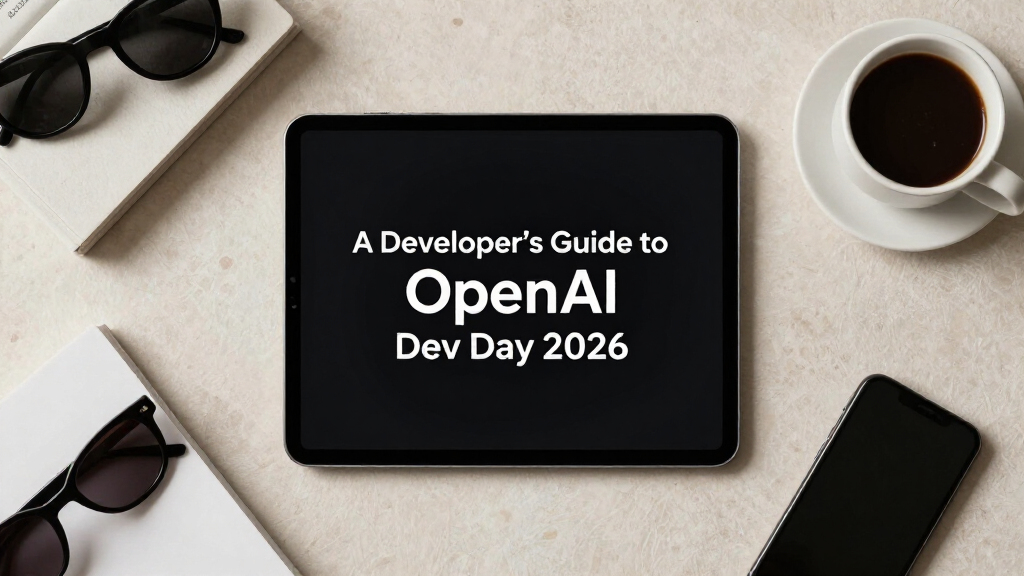

🔍 Read the full analysis: A Developer’s Guide To OpenAI Dev Day 2026 on ThorstenMeyerAI.com

Get business pricing on tech for your team
- Business-only prices and quantity discounts
- Tax-exempt purchasing
- Multiple users, one account, clear invoices
TL;DR
At DevDay on 29 September 2026, OpenAI announced more than 20 products and features, including Dots (always-on GPT-6 Astra agents), a major plugin upgrade, a Decisions API powered by GPT-6 Luna, computer use in the Agents API, Sign in with ChatGPT, and GPT-6.1 Sol at one-fifth of Astra’s token prices. The announcements shift OpenAI’s positioning from chatbot maker to agent platform, with major implications for how software is distributed and discovered.
OpenAI used its DevDay on 29 September 2026 to announce more than 20 products and features that move the company from chatbot provider to agent platform, pitching ChatGPT as a shared surface for humans and agents that reaches 1.2 billion weekly users. Five announcements carry the most weight for developers: Dots, an always-on personal agent platform; a sweeping plugin upgrade; a Decisions API built on GPT-6 Luna; computer use support in the Agents API; and Sign in with ChatGPT. For anyone who builds or sells software, the changes redefine how applications reach users inside ChatGPT’s ecosystem.
Dots are OpenAI’s biggest consumer bet: persistent agents powered by GPT-6 Astra, each running on its own cloud computer and browser, able to reach more than 4,000 apps through plugins. A dot works toward a user’s goals around the clock, learns preferences over time and can keep several projects moving at once. Access is available now for Pro and Business Premium users in eligible markets, with Enterprise, Edu and Healthcare access through an admin-enabled beta that is off by default. The first dot is included in the plan; chatting with it does not count toward usage limits, though tasks it starts in Codex or ChatGPT Work do. OpenAI says voice calls work today, with texting coming, and it envisions teams of dots working together later.
Control is a stated design constraint. Each dot operates on its own cloud computer, so user machines stay separate. Dots can use saved passwords without exposing them to the model, background “proactive research” is limited to read-only tools, and Custom Rules let users allow, require approval for or block specific actions. An Activity View shows background work, and monitoring can pause or stop a dot. OpenAI still warns that dots can make mistakes. An enterprise variant, specialist dots, gives agents their own identity, credentials and IT-provisioned hardware, with pilots starting in procurement, invoice processing, email marketing, customer support and commercial contracting, plus a planned Microsoft Agent 365 governance integration.
Plugins are now the way into ChatGPT, Codex and dots. Announcements include plugin extensions that live in the ChatGPT sidebar (Figma and Adobe showed integrations), a Plugin Creator with a new submission flow, improved discovery and ranking, Sites that host plugins for teams, and support for the proposed MCP Events specification so plugins can trigger automations when something happens in a connected app. An OpenAI Marketplace lets eligible enterprise customers spend part of their OpenAI commitment with 32 launch partners, including Figma, Adobe, Salesforce, ServiceNow, Harvey, CrowdStrike and Baseten. Separately, the Decisions API applies GPT-6 Luna to narrow, repetitive choices: developers define questions with a finite list of allowed answers and receive a selection usable for classification, routing or agent step selection. It is in limited preview. The Agents API now supports computer use, letting agents operate software through its interface, with OpenAI running the Codex harness. Sign in with ChatGPT lets users bring an existing plan to 16 launch partners, making a free-core-app-plus-paid-upsells model workable. On the model side, GPT-6.1 Sol offers what OpenAI describes as near-Astra intelligence at one-fifth of Astra’s token prices, alongside Ultrafast, Pro 500 and other additions.
OpenAI DevDay 2026 at a glance
The five launches that matter, plus Sol
The rest of the slate
Collaboration
ChatGPT SpacelivePagesliveCollaborative slidesnext few weeksTeams and Team Taskslive@ChatGPT in Slack and TeamsliveMeetings pluginbeta, macOSShareable profilesliveCodex
Codex CloudliveCLI refreshvoice, /agentsCode ReviewliveCodex Security CloudlivePlans, enterprise, speed
Pro 500$500, 25× PlusUltrafastAstra now, Sol soonPrivate IntelligencePrivate Inference this fallBedrock Managed Agentsruns in AWSOpenAI Marketplace32 partners, applyWhy Plugin Distribution Now Decides Revenue
The strategic stakes for builders are distribution. Because dots reach over 4,000 apps through the plugin ecosystem, plugin visibility increasingly decides who gets work from agents. The model OpenAI laid out in its commentary is outcome-driven selection: a customer asks for a result, ChatGPT understands the job, and a plugin is selected — meaning a business can be hired before the customer knows its name. That shifts competitive questions from brand marketing to why a given plugin was selected or ignored, pushing developers to measure intent, activation and completion inside the agent surface.
The Sign in with ChatGPT mechanism matters commercially as well: if users carry their existing OpenAI plans into third-party apps, developers can ship a free core product with paid upsells rather than handling billing from scratch. The OpenAI Marketplace extends this to enterprises with committed spend. For incumbents, the developer docs’ inclusion of conversion specs for restaurant reservations, quote requests and product checkout — and a guide for submitting a Claude Code plugin — suggests OpenAI wants to absorb skills and plugins built for other agent ecosystems, not just its own.
From Chatbot to Agent Platform
The DevDay announcements continue OpenAI’s multi-year expansion from a conversational chatbot into an operating layer for autonomous software. Previous DevDays introduced plugins, the Assistants API and early agent tooling; this year’s event consolidates those threads into a single architecture in which ChatGPT, Codex and dots all draw on the same shared plugin directory and MCP-based connections to external services.
The scale of the surface is the backdrop: OpenAI says ChatGPT now reaches 1.2 billion weekly users, which makes any change to how apps are discovered inside the product a material event for the software industry. The Model Context Protocol (MCP) events support also ties OpenAI’s ecosystem to a broader industry specification effort, and the Microsoft Agent 365 integration plan for specialist dots signals deeper enterprise governance tooling ahead.
Preview Limits and Unanswered Questions
Several announcements are not generally available. The Decisions API is in limited preview, with OpenAI promising a broad release without a confirmed date. Dot access is limited to Pro and Business Premium in eligible markets; OpenAI has not published a timeline for broader rollout, and texting support for dots is still forthcoming. The Microsoft Agent 365 governance integration for specialist dots is planned rather than shipped.
Performance claims also remain vendor statements rather than independently verified results: OpenAI characterizes GPT-6.1 Sol as offering “near-Astra intelligence” at one-fifth of Astra’s token prices, but developers will need to benchmark the model on their own workloads. OpenAI’s own warning that dots can make mistakes leaves open how reliably the agent platform performs unsupervised background work at scale. Pricing for additional dots, extra speed and higher monthly output per dot has been described only at a high level.
Rollouts and Release Dates to Track
Developers should watch for the Decisions API’s broad release, which OpenAI says is coming, and for expansion of dot availability beyond Pro and Business Premium tiers. The arrival of texting support for dots and OpenAI’s vision of teams of dots working together are the next functional milestones on the consumer side. On the enterprise side, the specialist-dot pilots in procurement, invoice processing, email marketing, customer support and commercial contracting will indicate whether IT-governed agents move from pilot to production, alongside the planned Microsoft Agent 365 integration.
For builders, the immediate next steps are practical: use the Plugin Creator and new submission flow to publish into the shared directory, prepare for MCP Events-based automations, evaluate GPT-6.1 Sol against current model costs, and decide whether to adopt Sign in with ChatGPT for their own apps. Marketplace eligibility for enterprise customers and the 32 launch partners will also expand over time, though OpenAI has not announced a schedule.
Key Questions
What are Dots in OpenAI’s DevDay 2026 announcements?
Dots are always-on personal agents powered by GPT-6 Astra. Each dot runs on its own cloud computer and browser, reaches over 4,000 apps through plugins, and works on a user’s goals continuously. They are available now for Pro and Business Premium users in eligible markets, with the first dot included in the plan.
When can developers use the Decisions API?
It is currently in limited preview. OpenAI has promised a broad release but has not confirmed a date. The API uses GPT-6 Luna to answer narrow, predefined questions with a finite list of allowed answers.
How much does GPT-6.1 Sol cost compared to Astra?
According to OpenAI, GPT-6.1 Sol offers near-Astra intelligence at one-fifth of Astra’s token prices. This is a vendor claim; developers should benchmark it on their own workloads before switching.
Why do plugins matter more after DevDay 2026?
Plugins are now the distribution layer for ChatGPT, Codex and dots, connecting agents to over 4,000 apps. Because agents select plugins based on the outcome a user asks for, plugin discovery and conversion quality can determine whether a business receives work through the platform.
What safeguards do Dots have?
Each dot runs on a separate cloud computer, can use saved passwords without exposing them to the model, and is restricted to read-only tools for background research. Custom Rules let users allow, require approval for or block actions, an Activity View shows background work, and sensitive tasks like password changes always stay with the user. OpenAI cautions that dots can still make mistakes.
Source: ThorstenMeyerAI.com
Fall Picks
fall essentials
As an affiliate, we earn on qualifying purchases.