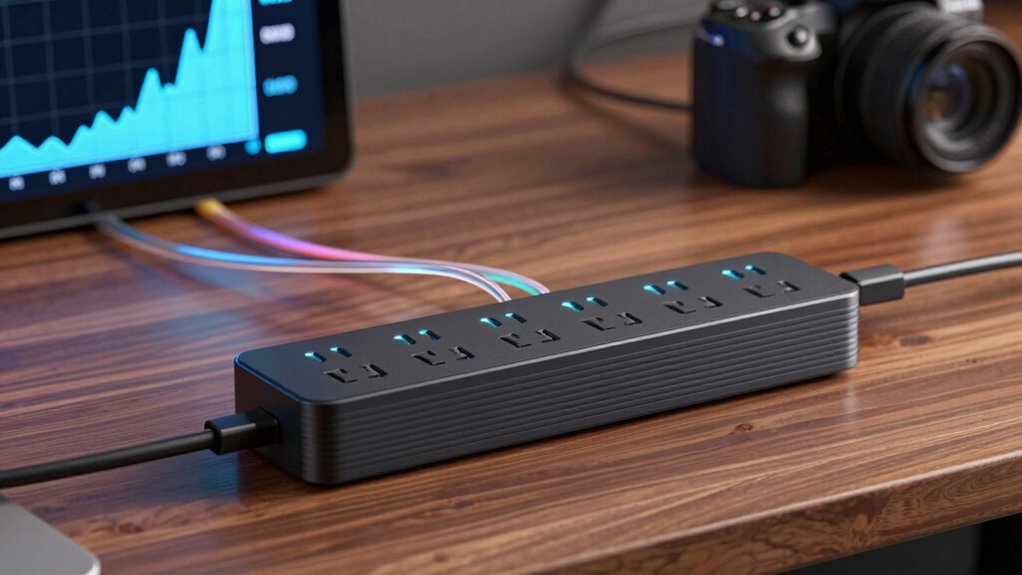

Choosing the right smart power strip with energy monitoring depends on your specific needs, whether it’s home automation, energy savings, or platform compatibility. In 2026, the GHome Smart Power Strip stands out for its affordability and straightforward control, making it ideal for those new to smart home tech. Meanwhile, the Tapo P316M offers broader compatibility and local control, which appeals to users seeking a more integrated and secure setup. Both models deliver essential energy tracking, but they differ significantly in connectivity, automation complexity, and ecosystem support—factors that influence the best choice for you.

Get business pricing on tech for your team
- Business-only prices and quantity discounts
- Tax-exempt purchasing
- Multiple users, one account, clear invoices
Key Takeaways
- The GHome model is best for budget-conscious users who want straightforward Alexa or Google control and energy monitoring.
- The Tapo P316M offers broader platform compatibility, including Apple HomeKit and Samsung SmartThings, and supports local control during internet outages.
- Both options have limitations: GHome relies solely on 2.4GHz WiFi, while Tapo’s shorter power cord may restrict placement.
- Energy monitoring is a feature in both, but Tapo’s ability to manage nine devices simultaneously makes it more scalable.
- Deciding between these depends on your preferred ecosystem, network setup, and whether local control or advanced automation is more critical.
| GHome Smart Power Strip with Energy Monitoring, 6 WiFi Outlets & 30W USB-C Fast Charging |  | Best Overall for Simplicity and Value | Number of Outlets: 6 WiFi outlets | USB Ports: 2 USB-A, 1 USB-C | WiFi Compatibility: 2.4GHz WiFi only | VIEW ON AMAZON | See Our Full Breakdown |
| Tapo Smart Wi-Fi Power Strip, Matter, P316M, Energy Monitoring |  | Best for Compatibility and Local Control | Number of Outlets: 6 controllable AC outlets | USB Ports: 3 (5V 2.4A) always-on | Power Cord Length: 3 feet | VIEW ON AMAZON | See Our Full Breakdown |
| smart power strip energy monitoring | Number of Outlets | USB Ports | WiFi Compatibility | Extension Cord Length |
|---|---|---|---|---|
| GHome Smart Power Strip with E | 6 WiFi outlets | 2 USB-A, 1 USB-C | 2.4GHz WiFi only | 7.2 ft |
| Tapo Smart Wi-Fi Power Strip | 6 controllable AC outlets | 3 (5V 2.4A) always-on | — | — |
More Details on Our Top Picks
GHome Smart Power Strip with Energy Monitoring, 6 WiFi Outlets & 30W USB-C Fast Charging
The GHome Smart Power Strip offers six WiFi-controlled outlets plus multiple USB ports, making it a versatile choice for managing various devices. Its energy monitoring capability helps identify power hogs, which can lead to savings over time. Support for Alexa and Google Home ensures easy voice control, and its compact design minimizes space clutter. However, its reliance on 2.4GHz WiFi limits network performance, and without a hub, some advanced automations may be out of reach. Compared with the Tapo, it’s more straightforward but less flexible in platform support.
Pros:- Supports voice commands via Alexa and Google Home
- Includes energy monitoring to help reduce power waste
- Compact, space-saving flat plug design
- Multiple outlets and fast-charging USB ports
Cons:- Limited to 2.4GHz WiFi, restricting network flexibility
- No hub or local control options
- Requires WiFi connection for all smart features
Best for: Home users seeking a simple, cost-effective smart strip with basic energy insights.
Not ideal for: Advanced smart home setups requiring local control or multi-platform integration.
- Number of Outlets:6 WiFi outlets
- USB Ports:2 USB-A, 1 USB-C
- WiFi Compatibility:2.4GHz WiFi only
- Extension Cord Length:7.2 ft
- Control:Voice and app control via Alexa and Google Home
- Features:Energy monitoring, scheduling, timers
Our verdict“A solid choice for users new to smart home automation who want easy setup and decent energy monitoring at an affordable price.”
Tapo Smart Wi-Fi Power Strip, Matter, P316M, Energy Monitoring
The Tapo P316M stands out with its broad ecosystem support, including Apple HomeKit, Samsung SmartThings, and Alexa, Google Assistant, plus Bixby. It features six controllable outlets and three USB ports, all supporting energy monitoring. Its Matter certification ensures future-proofing as more smart devices adopt this standard. One of its key advantages is local control—operating even without an internet connection—making it reliable for critical automation. On the downside, setup can be more involved due to firmware updates and app configuration, and its short 3-foot power cord may limit placement options. Compared to GHome, it offers greater flexibility but at a slightly higher complexity and cost.
Pros:- Supports up to 9 devices simultaneously with individual control
- Energy monitoring helps optimize power usage
- Compatible with Apple HomeKit, SmartThings, Alexa, Google
- Local control works during internet outages
Cons:- Requires app setup and firmware updates for optimal operation
- Limited to a 3-foot power cord, restricting placement
- No explicit surge protection features mentioned
Best for: Power users who want broad ecosystem compatibility and reliable local control.
Not ideal for: Users who prefer a simple, plug-and-play device or need a longer power cord.
- Number of Outlets:6 controllable AC outlets
- USB Ports:3 (5V 2.4A) always-on
- Power Cord Length:3 feet
- Energy Monitoring:Yes
- Voice Control:Siri, Alexa, Google Assistant, Bixby
- Connectivity:Wi-Fi, LAN
- Compatibility:Matter-certified, works with major platforms
- Security:Cybersecurity and Infrastructure Security Agency’s Secure-by-Design pledge
Our verdict“This pick caters to those who prioritize ecosystem integration, security, and local operation, making it suitable for advanced smart home setups.”

How We Picked
Our selection process focused on key features that matter for energy monitoring and smart home integration. We prioritized products with multiple controllable outlets, compatibility with popular voice assistants, and real-time energy tracking. Ease of setup and platform support also played a critical role, alongside user safety features like security protocols. We aimed to highlight options suitable for different user needs—whether beginners seeking simplicity or advanced users requiring extensive ecosystem integration.
Factors to Consider When Choosing Smart Power Strip Energy Monitoring
When selecting a smart power strip for energy monitoring, it’s essential to consider compatibility with your existing smart home ecosystem, whether local control is important, and the type of automation you need. While features like multiple outlets, USB ports, and real-time energy tracking are standard, the way these are integrated varies. Understanding your network setup, space constraints, and automation preferences will help you choose the right model to maximize both convenience and energy savings.
Compatibility and Ecosystem Support
Choose a model that works seamlessly with your preferred voice assistants and smart home platforms. The GHome is excellent for Alexa and Google users seeking straightforward control, but it lacks support for Apple HomeKit or SmartThings. The Tapo P316M offers broader compatibility, including Matter certification, which future-proofs your setup and ensures it works with many platforms, including Apple’s ecosystem. Consider your existing smart devices to avoid compatibility headaches and ensure smooth automation integration.
Control Type and Network Requirements
Decide whether you want cloud-based control or local operation. The GHome relies solely on WiFi, which means if your internet drops, smart functions could be affected. The Tapo model supports local control through LAN, which maintains operation during outages—a big plus for reliability. Also, check the WiFi bands supported; GHome’s 2.4GHz only might limit performance if your network is congested, while Tapo’s support for LAN offers a more stable connection.
Number of Outlets and Ports
Assess how many devices you need to control and whether USB charging ports are necessary. The GHome provides six outlets and multiple USB ports, suitable for managing various home devices. The Tapo also offers six outlets but includes three USB ports with continuous power, ideal for charging devices without interrupting automation. If you need to control many devices or want dedicated charging, consider which model aligns better with your needs.
Energy Monitoring and Automation Features
Both products include energy monitoring, a feature that can help you identify power drains and reduce costs. The Tapo’s ability to manage nine devices simultaneously offers more scalability for larger setups. Automation features like scheduling and timers are standard, but the Tapo’s advanced ecosystem support makes complex routines easier to implement, especially if you’re integrating with other smart devices.
Frequently Asked Questions
Do I need a hub for these smart power strips?
No, both the GHome and Tapo models operate over WiFi and do not require a separate hub, simplifying setup and reducing additional costs. However, the Tapo’s support for local LAN control can provide more reliable operation during internet outages, which might be a consideration for critical automation scenarios.
Can I control these devices with my voice?
Yes, both options support voice control. The GHome works with Alexa and Google Home, making it straightforward for users of those platforms. The Tapo P316M also supports Alexa, Google Assistant, Siri, and Bixby, giving you broader voice assistant compatibility and flexibility in how you manage your devices.
Is energy monitoring accurate and useful?
Both products provide real-time energy usage data, which can help you identify power-hungry devices and optimize your energy consumption. While the accuracy depends on the device’s internal sensors, these features generally give a good overview of your energy patterns, enabling smarter decisions and potential savings over time.
Are these smart power strips safe to use?
Yes, both products are designed with safety in mind, featuring built-in protections such as overcurrent and surge protection (though the Tapo model does not explicitly list surge protection). It’s important to follow manufacturer guidelines and avoid overloading outlets to maintain safety. Always check for certification marks to ensure compliance with safety standards.
Can I use these with other smart devices?
Absolutely. Both models support integration with popular smart home platforms, allowing you to incorporate them into routines and automations with other devices. The Tapo’s broader ecosystem support and Matter certification make it particularly versatile, especially if you plan to expand your smart home ecosystem in the future.
Conclusion
If you’re just starting out or want an affordable, easy-to-use smart power strip, the GHome model offers reliable energy monitoring with basic voice control. For those with a more advanced setup, seeking broader compatibility, local control, and future-proofing, the Tapo P316M makes a compelling choice. Your decision should hinge on your existing smart home ecosystem, network preferences, and whether local operation is a priority for your automation needs.